

Shandong Do Sender Chemicals Co.,Ltd.
- Refrigerants
- Second-generation
- Third-generation
- Blended refrigerant
- Fourth-generation
- UV Series
- UV absorber
- Light stabilizers
- Melanin
- …
- Refrigerants
- Second-generation
- Third-generation
- Blended refrigerant
- Fourth-generation
- UV Series
- UV absorber
- Light stabilizers
- Melanin
Shandong Do Sender Chemicals Co.,Ltd.
- Refrigerants
- Second-generation
- Third-generation
- Blended refrigerant
- Fourth-generation
- UV Series
- UV absorber
- Light stabilizers
- Melanin
- …
- Refrigerants
- Second-generation
- Third-generation
- Blended refrigerant
- Fourth-generation
- UV Series
- UV absorber
- Light stabilizers
- Melanin
R407C
Pentafluoroethane/Difluoroethane/Tetrafluoroethane(R407C)
CAS No.: 354-33-6/811-97-2/75-10-5 UN No.: 3340 CLASS No.: 2.2 Molecular formula: CF3CH2F/CF3CHF2/CH2F2
R407c is blended by R32, R134a and R125, which is a colorless gas at room temperature and a colorless transparent liquid at its own pressure, mainly used in low to medium temperature refrigeration systems.
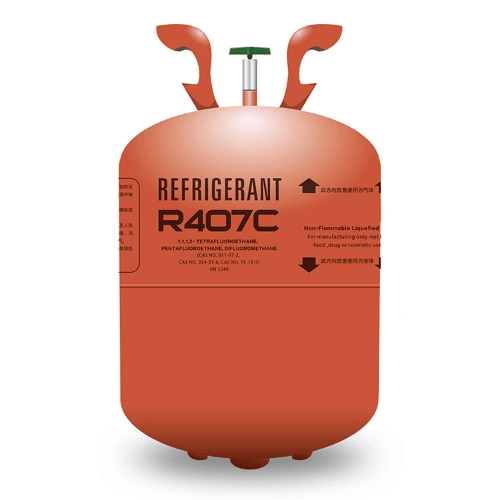
R407C
R407C is a zeotropic hydrofluorocarbon (HFC) refrigerant blend consisting of three components: R-32 (23%), R-125 (25%), and R-134a (52%) by weight. It was developed as a replacement for R-22 in existing medium-temperature refrigeration and air conditioning systems with minimal modifications required.
Applications
Medium-Temperature Air Conditioning
R407C is commonly used in direct expansion (DX) air conditioning systems including split systems, packaged units, and rooftop systems.
Commercial Refrigeration
Suitable for medium-temperature refrigeration applications including supermarket display cases, cold rooms, and food processing facilities.
Chillers
Both air-cooled and water-cooled chillers originally designed for R-22 can be retrofitted to use R407C.
Heat Pumps
R407C can be used in heat pump systems for both heating and cooling operations.
Physical & Chemical Properties
Physical Properties
Boiling Point Range: -43.8°C to -36.7°C (-46.8°F to -34.1°F)
Bubble Point (1 atm): -43.8°C (-46.8°F)
Dew Point (1 atm): -36.7°C (-34.1°F)
Critical Temperature: ~86°C (186.8°F)
Critical Pressure: ~4.6 MPa (667 psia)
Liquid Density (25°C): ~1,140 kg/m³
Vapor Density (air=1): ~3.7
ODP (Ozone Depletion): 0
GWP (Global Warming): 1,774 (IPCC AR5)
Flammability: A1 - Non-flammable (R32 flammability suppressed by R125/R134a)
Thermodynamic Characteristics
Temperature Glide: ~7°C (12.6°F) at atmospheric pressure. Requires system design adjustments (e.g., flooded evaporators, careful piping) to minimize performance loss.
Capacity & Efficiency: Similar to R22, with ~5% lower cooling capacity but comparable COP in optimized systems.
Pressure: Operating pressures ~10% higher than R22.
Discharge Temperature: Lower than R22, beneficial for compressor longevity.
Material Compatibility & Handling
Lubricant: Polyol Ester (POE) Oil - Must be used, as R407C is not miscible with mineral oil.
Seal Materials: Compatible with HNBR, EPDM, Neoprene. Avoid natural rubber.
Leak Detection: Use electronic halogen leak detectors.
Charging Method: Must be charged as a liquid to prevent composition shift.
Service Practice: Requires dedicated recovery cylinders (not mixed with other refrigerants).
Packaging, Storage & Transportation
Packaging
Cylinders: 10kg, 20kg, 50kg disposable steel cylinders
Drums: 500kg and 1000kg returnable steel drums
ISO Containers: Bulk shipments in ISO tank containers for large volume users
Storage
Store in a cool, dry, well-ventilated area away from direct sunlight and heat sources
Maximum storage temperature: 52°C (125°F)
Keep containers tightly closed when not in use
Store away from combustible materials and oxidizing agents
Ensure proper segregation from incompatible chemicals
Transportation
UN Number: UN3338
Proper Shipping Name: Refrigerant gas, n.o.s. (R-32, R-125, R-134a)
Hazard Class: 2.2 (Non-flammable, non-toxic gas)
Packing Group: Not applicable
Transport Labels: Non-flammable gas label required
Complies with regulations including IMDG, IATA, and ADR for international transport
FAQ
What is R407C refrigerant?
What are the CAS numbers for R407C components?
Is R407C compatible with R-22 systems?
What is the temperature glide of R407C?
What is the global warming potential (GWP) of R407C?
Is R407C flammable?
What lubricant is compatible with R407C?
What is the boiling point of R407C?
Can R407C be mixed with R-22?
What is the chemical formula for R-32 (CAS 811-97-2)?
How should R407C cylinders be stored?
What is the critical temperature of R407C?
What are the main applications for R407C?
What is the ozone depletion potential (ODP) of R407C?
How does R407C compare to R410A?
What is the chemical name for CAS 354-33-6?
Can R407C be used in automotive air conditioning?
What safety precautions are needed when handling R407C?
What is the proper disposal method for R407C?
What is the chemical name for CAS 75-10-5?
Is R407C being phased out under regulations?
What are the environmental impacts of R407C?
Refrigerants
Second Refrigerant
R22
Third Generation
R32
R23
HFC-143A
R134A
HFC-125
R152A
Blended Refrigerant
R404A
R407C
R410A
R507A
Fourth Generation
R1234YF
UV Series
UV absorber
UV-1164
BP-2
UV-1
UV-123
UV-327
UV-P
UV-329
UV-1130
Light satabilizers
UV-292
UV-770
Melanin
2-Anilino-6-(dibutylamino)-3-me
Other chemicals
2-Hydroxy-2methylpropiophenone
1,3-benzothiazol-2-ylsulfanylme
4-Chloro-3,5-dimethylphenol (CA
About
Home
News
Contact
© 2025 Shandong Do Sender Chemicals Co.,Ltd. All rights reserved.
Sales Office Address:No. 66, Zhongrun Avenue, Zhangdian District, Zibo City, Shandong Province,China.
Manufacture Facility: Fine Chemical Industry Park, Zhangdian District, Zibo City, Shandong Province,China.
Refrigerants +86 15315229135 +8616678643891 Email:wings.fu@dosenderchem.com.cn quinn.gong@dosenderchem.com.cn