

Shandong Do Sender Chemicals Co.,Ltd.
- Refrigerants
- Second-generation
- Third-generation
- Blended refrigerant
- Fourth-generation
- UV Series
- UV absorber
- Light stabilizers
- Melanin
- …
- Refrigerants
- Second-generation
- Third-generation
- Blended refrigerant
- Fourth-generation
- UV Series
- UV absorber
- Light stabilizers
- Melanin
Shandong Do Sender Chemicals Co.,Ltd.
- Refrigerants
- Second-generation
- Third-generation
- Blended refrigerant
- Fourth-generation
- UV Series
- UV absorber
- Light stabilizers
- Melanin
- …
- Refrigerants
- Second-generation
- Third-generation
- Blended refrigerant
- Fourth-generation
- UV Series
- UV absorber
- Light stabilizers
- Melanin
R32
Industrial Difluoromethane (R32)
CAS No.: 75-10-5 UN No.: 3252 CLASS No.: 2.1 Molecular formula: CH₂F₂
It is mainly used as a refrigerant, a substitute for the low-temperature refrigerant R-502, or formulated into blended refrigerants with HFC-134a and HFC-152a respectively to replace HCFC-22.
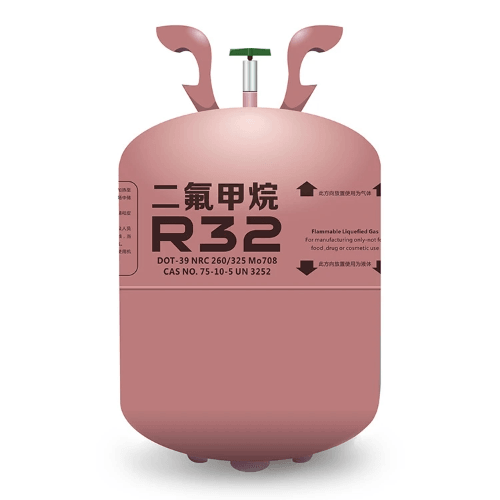
R32
R32 (Difluoromethane, CAS No. 75-10-5) is a hydrofluorocarbon (HFC) refrigerant with a single component, zero ozone depletion potential (ODP), and significantly lower global warming potential (GWP) compared to traditional refrigerants like R410A. As an emerging alternative in air conditioning applications, R32 offers improved energy efficiency and environmental performance
Applications
Residential Air Conditioning
Split-type and multi-split air conditioners
Commercial AC Systems
Packaged air conditioners and VRF systems
Heat Pumps
Air-to-water and air-to-air heat pumps
Refrigeration
Commercial refrigeration equipment
Retrofit Applications
Retrofitting R22 and R410A systems
Low-GWP Solutions
Compliance with environmental regulations
Physical & Chemical Properties
Physical Properties
Molecular Weight: 52.02 g/mol
Boiling Point: (at 1 atm)-51.7 °C (-61.1 °F)
Freezing Point: -136.8 °C (-214.2 °F)
Critical Temperature: 78.1 °C (172.6 °F)
Critical Pressure: 5.78 MPa (838 psia)
Critical Density: 424 kg/m³
Liquid Density (at 25°C): ~950 kg/m³
Vapor Density (air=1): 1.8 (heavier than air)
Specific Heat (Liquid, 25°C): ~1.57 kJ/(kg·K)
Specific Heat (Vapor, 25°C): ~0.83 kJ/(kg·K)
Thermal Conductivity: Higher than R410A, improving heat exchanger efficiency.
Viscosity: Lower than R410A, reducing pressure drop in systems.
Chemical & Safety Properties
Flammability: Class A2L. Mildly flammable. It has a low burning velocity and a high Lower Flammability Limit (LFL), making it harder to ignite and sustain a flame compared to hydrocarbons.
Lower Flammability Limit (LFL): 14.4% by volume in air.
Upper Flammability Limit (UFL): 29.3% by volume in air.
Auto-Ignition Temperature: 648 °C (1198 °F)
ODP (Ozone Depletion Potential): 0 – Does not deplete the ozone layer.
GWP (Global Warming Potential): 675 (IPCC AR5, 100-yr). This is about 1/3 of R410A's GWP (~2088).
Atmospheric Lifetime: ~5.2 years (much shorter than R410A).
Toxicity: Class A (Low Toxicity). However, at high concentrations, it can act as a simple asphyxiant and, like all refrigerants, decompose into toxic fumes (HF, carbonyl fluoride) if exposed to an open flame or extreme heat.
Thermodynamic & Performance
High Volumetric Cooling Capacity: Approximately 1.5 times greater than R410A. This means smaller displacement compressors can be used for the same cooling effect.
C.O.P. (Coefficient of Performance): Similar to or slightly higher than R410A, offering good energy efficiency.
Glide: Near Azeotropic (~0.5 K). It behaves almost like a single-component refrigerant, simplifying system design and service.
Discharge Temperature: Higher than R410A, which requires specific compressor design considerations for reliability.
Packaging, Storage & Transportation
Cylinder Sizes
Available in 10 lb, 25 lb, 30 lb, 50 lb disposable cylinders. Also offered in 100 lb, 500 lb, 1,000 lb recovery cylinders for reclaimed R32.
Bulk Containers
For large-scale use: 1-ton cylinders and ISO tank containers are available for industrial applications and reclamation facilities.
Storage Conditions
Store in a cool, dry, well-ventilated area away from direct sunlight, heat sources, open flames, and ignition sources. Cylinder temperature must not exceed 52°C (125°F). Keep cylinders upright and secured, and avoid mixing with oxidizers or corrosive substances.
Transportation
Classified as UN 3252, Difluoromethane (R32), a Class 2.1 Flammable Gas. Transport using dedicated hazardous goods vehicles with fire-fighting equipment and anti-leakage measures. Secure cylinders upright with valve protection caps in place; avoid high-temperature exposure and direct sunlight. Drivers and handlers must hold hazardous goods operation certifications.
FAQ
What is R32 refrigerant and what is its CAS number?
What is the global warming potential (GWP) of R32 (CAS 75-10-5)?
Is R32 (Difluoromethane) flammable?
What are the main applications of R32 refrigerant?
Can R32 (CAS 75-10-5) be used as a drop-in replacement for R410A?
What is the boiling point of R32 refrigerant?
How does R32 compare to R410A in terms of efficiency?
What safety precautions should be taken when handling R32?
What types of lubricants are compatible with R32 systems?
What is the critical temperature of R32 (Difluoromethane)?
How does R32 contribute to reducing greenhouse gas emissions?
What are the environmental regulations affecting R32 use?
What is the molecular weight of R32 (CAS 75-10-5)?
Can R32 be recovered and recycled?
What are the storage requirements for R32 cylinders?
How does R32 perform in high ambient temperature conditions?
What is the chemical stability of R32 under normal operating conditions?
What are the recommended leak detection methods for R32 systems?
How does the cost of R32 compare to other refrigerants?
Refrigerants
Second Refrigerant
R22
Third Generation
R32
R23
HFC-143A
R134A
HFC-125
R152A
Blended Refrigerant
R404A
R407C
R410A
R507A
Fourth Generation
R1234YF
UV Series
UV absorber
UV-1164
BP-2
UV-1
UV-123
UV-327
UV-P
UV-329
UV-1130
Light satabilizers
UV-292
UV-770
Melanin
2-Anilino-6-(dibutylamino)-3-me
Other chemicals
2-Hydroxy-2methylpropiophenone
1,3-benzothiazol-2-ylsulfanylme
4-Chloro-3,5-dimethylphenol (CA
About
Home
News
Contact
© 2025 Shandong Do Sender Chemicals Co.,Ltd. All rights reserved.
Sales Office Address:No. 66, Zhongrun Avenue, Zhangdian District, Zibo City, Shandong Province,China.
Manufacture Facility: Fine Chemical Industry Park, Zhangdian District, Zibo City, Shandong Province,China.
Refrigerants +86 15315229135 +8616678643891 Email:wings.fu@dosenderchem.com.cn quinn.gong@dosenderchem.com.cn