

Shandong Do Sender Chemicals Co.,Ltd.
- Refrigerants
- Second-generation
- Third-generation
- Blended refrigerant
- Fourth-generation
- UV Series
- UV absorber
- Light stabilizers
- Melanin
- …
- Refrigerants
- Second-generation
- Third-generation
- Blended refrigerant
- Fourth-generation
- UV Series
- UV absorber
- Light stabilizers
- Melanin
Shandong Do Sender Chemicals Co.,Ltd.
- Refrigerants
- Second-generation
- Third-generation
- Blended refrigerant
- Fourth-generation
- UV Series
- UV absorber
- Light stabilizers
- Melanin
- …
- Refrigerants
- Second-generation
- Third-generation
- Blended refrigerant
- Fourth-generation
- UV Series
- UV absorber
- Light stabilizers
- Melanin
R23
Trifluoromethane
CAS No.: 75-46-7 UN No.: 1984 CLASS No.: 2.2 Molecular formula: CHF₃
It is mainly used as a low-temperature refrigerant and a fire extinguishing agent.
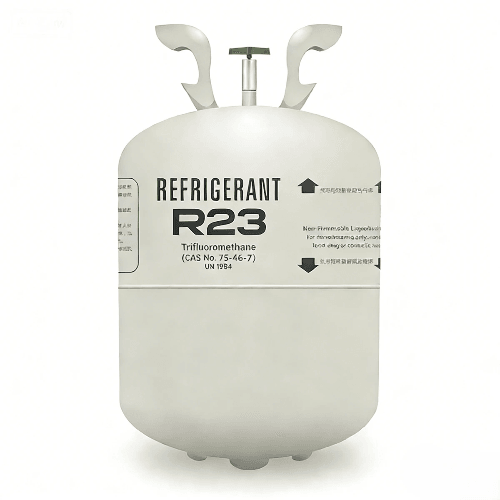
R23
R23 (Trifluoromethane), also known as Fluoroform or CHF₃, is a colorless, non-flammable gas with a faint ethereal odor. With CAS registry number 75-46-7, it is classified as a hydrofluorocarbon (HFC) refrigerant with zero ozone depletion potential (ODP).
Applications
Refrigeration & Cryogenics
Laboratory freezers and environmental test chambers
Medical and pharmaceutical cold storage
Food freezing and preservation systems
Superconducting magnet cooling
Semiconductor Manufacturing
Plasma etching of silicon-based materials
Chamber cleaning in CVD and PVD processes
Dielectric etching for advanced node semiconductors
Fire Suppression
R23's high density and non-flammable properties make it suitable for specialized fire suppression systems, particularly for protecting high-value electrical equipment.
Research & Analytical Chemistry
Supercritical fluid extraction (SFE)
NMR spectroscopy as a fluorine source
Atmospheric and climate research
Chemical synthesis of fluorinated compounds
Physical & Chemical Properties
Physical Properties
Molecular Weight: 52.02 g/mol
Boiling Point: (at 1 atm)-51.7 °C (-61.1 °F)
Freezing Point: -136.8 °C (-214.2 °F)
Critical Temperature: 78.1 °C (172.6 °F)
Critical Pressure: 5.78 MPa (838 psia)
Critical Density: 424 kg/m³
Liquid Density (at 25°C): ~950 kg/m³
Vapor Density (air=1): 1.8 (heavier than air)
Specific Heat (Liquid, 25°C): ~1.57 kJ/(kg·K)
Specific Heat (Vapor, 25°C): ~0.83 kJ/(kg·K)
Thermal Conductivity: Higher than R410A, improving heat exchanger efficiency.
Viscosity: Lower than R410A, reducing pressure drop in systems.
Chemical & Safety Properties
Flammability: Class A2L. Mildly flammable. It has a low burning velocity and a high Lower Flammability Limit (LFL), making it harder to ignite and sustain a flame compared to hydrocarbons.
Lower Flammability Limit (LFL): 14.4% by volume in air.
Upper Flammability Limit (UFL): 29.3% by volume in air.
Auto-Ignition Temperature: 648 °C (1198 °F)
ODP (Ozone Depletion Potential): 0 – Does not deplete the ozone layer.
GWP (Global Warming Potential): 675 (IPCC AR5, 100-yr). This is about 1/3 of R410A's GWP (~2088).
Atmospheric Lifetime: ~5.2 years (much shorter than R410A).
Toxicity: Class A (Low Toxicity). However, at high concentrations, it can act as a simple asphyxiant and, like all refrigerants, decompose into toxic fumes (HF, carbonyl fluoride) if exposed to an open flame or extreme heat.
Thermodynamic & Performance
High Volumetric Cooling Capacity: Approximately 1.5 times greater than R410A. This means smaller displacement compressors can be used for the same cooling effect.
C.O.P. (Coefficient of Performance): Similar to or slightly higher than R410A, offering good energy efficiency.
Glide: Near Azeotropic (~0.5 K). It behaves almost like a single-component refrigerant, simplifying system design and service.
Discharge Temperature: Higher than R410A, which requires specific compressor design considerations for reliability.
Packaging, Storage & Transportation
Cylinder Sizes
Available in 10 lb, 25 lb, 30 lb, 50 lb disposable cylinders. Also offered in 100 lb, 500 lb, 1,000 lb recovery cylinders for reclaimed R23.
Storage Recommendations
Store in a well-ventilated, dry area away from direct sunlight and heat sources
Maintain storage temperature below 52°C (125°F)
Keep containers tightly closed and properly labeled
Store away from combustible materials and oxidizing agents
Use first-in, first-out (FIFO) inventory system
Transportation & Handling
Transport in upright position and secure to prevent tipping
Use appropriate personal protective equipment (safety glasses, gloves)
Ensure adequate ventilation during transfer operations
Use pressure-regulating equipment compatible with gas service
Do not drop, drag, or roll cylinders
FAQ
What is R23 and what does CAS No. 75-46-7 represent?
What are the primary industrial uses of R23 gas?
Is R23 flammable or explosive under normal conditions?
What is the global warming potential (GWP) of R23 compared to CO2?
Does R23 deplete the ozone layer like CFC refrigerants?
What are the safety considerations when handling R23 gas?
What is the boiling point of R23 at atmospheric pressure?
Can R23 be mixed with other refrigerants?
What is the critical temperature and pressure of R23?
How is R23 typically packaged for industrial use?
What are the environmental regulations governing R23 use?
What is the solubility of R23 in water and common solvents?
What are the thermal decomposition products of R23?
How does the density of R23 compare to air?
What is the vapor pressure of R23 at 25°C?
Is R23 compatible with common construction materials?
What analytical methods are used to detect and quantify R23?
What is the autoignition temperature of R23?
How should R23 cylinders be stored safely?
What is the typical purity of commercial R23 and common impurities?
What are the first aid measures for R23 exposure?
What is the historical production method for R23?
How does R23 compare to R13 and R14 in refrigeration applications?
What are the recommended PPE for handling R23?
Refrigerants
Second Refrigerant
R22
Third Generation
R32
R23
HFC-143A
R134A
HFC-125
R152A
Blended Refrigerant
R404A
R407C
R410A
R507A
Fourth Generation
R1234YF
UV Series
UV absorber
UV-1164
BP-2
UV-1
UV-123
UV-327
UV-P
UV-329
UV-1130
Light satabilizers
UV-292
UV-770
Melanin
2-Anilino-6-(dibutylamino)-3-me
Other chemicals
2-Hydroxy-2methylpropiophenone
1,3-benzothiazol-2-ylsulfanylme
4-Chloro-3,5-dimethylphenol (CA
About
Home
News
Contact
© 2025 Shandong Do Sender Chemicals Co.,Ltd. All rights reserved.
Sales Office Address:No. 66, Zhongrun Avenue, Zhangdian District, Zibo City, Shandong Province,China.
Manufacture Facility: Fine Chemical Industry Park, Zhangdian District, Zibo City, Shandong Province,China.
Refrigerants +86 15315229135 +8616678643891 Email:wings.fu@dosenderchem.com.cn quinn.gong@dosenderchem.com.cn