

Shandong Do Sender Chemicals Co.,Ltd.
- Refrigerants
- Second-generation
- Third-generation
- Blended refrigerant
- Fourth-generation
- UV Series
- UV absorber
- Light stabilizers
- Melanin
- …
- Refrigerants
- Second-generation
- Third-generation
- Blended refrigerant
- Fourth-generation
- UV Series
- UV absorber
- Light stabilizers
- Melanin
Shandong Do Sender Chemicals Co.,Ltd.
- Refrigerants
- Second-generation
- Third-generation
- Blended refrigerant
- Fourth-generation
- UV Series
- UV absorber
- Light stabilizers
- Melanin
- …
- Refrigerants
- Second-generation
- Third-generation
- Blended refrigerant
- Fourth-generation
- UV Series
- UV absorber
- Light stabilizers
- Melanin
R134A
1,1,1,2-Tetrafluoroethane
CAS No.: 811-97-2 UN No.: 3159 CLASS No.: 2.2 Molecular formula: C₂H₂F₄
It is used as a refrigerant for refrigerators, chillers and automotive air conditioning systems, and also as an aerosol propellant for pharmaceuticals and cosmetics.
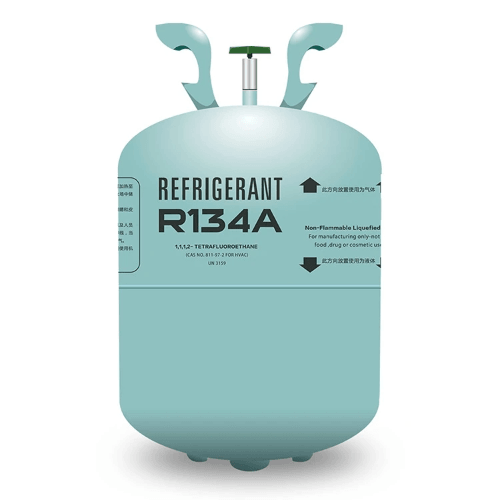
R134a
R134a (1,1,1,2-Tetrafluoroethane) is a hydrofluorocarbon (HFC) refrigerant with the chemical formula CF₃CH₂F and CAS number 811-97-2. It is a non-ozone-depleting refrigerant developed as a replacement for R12 (CFC-12) in many applications.
Applications
Stationary Air Conditioning
Primary refrigerant in mobile AC systems for passenger cars, trucks, and buses. Replaced R12 in the 1990s.
Residential & Commercial Refrigeration
Used in refrigerators, freezers, and display cases. Common in medium-temperature applications.
Stationary Air Conditioning
Applied in chillers, heat pumps, and HVAC systems for commercial buildings.
Aerosol Propellant
Used as a propellant in medical and technical aerosols, replacing CFCs.
Medical Devices
Cooling agent in MRI machines and other medical equipment requiring precise temperature control.
Transport Refrigeration
Used in refrigerated containers and trucks for food and pharmaceutical transport.
Physical & Chemical Properties
Basic & Physical Properties
Molecular Weight: 102.03 g/mol
Boiling Point (1 atm): -26.1°C (-14.9°F)
Critical Temperature: 101.1°C (214°F)
Critical Pressure: 4.06 MPa (589 psia)
Liquid Density (25°C): ~1,210 kg/m³
Vapor Density (air=1): 3.5 (Heavier than air)
Ozone Depletion Potential (ODP): 0
Global Warming Potential (GWP): 1430 (IPCC AR5)
Environmental & Safety
Flammability: Non-flammable under normal conditions (A1).
Toxicity: Low toxicity (A1). High concentrations can cause asphyxiation.
Stability: Chemically stable. Avoid open flames (decomposes to toxic HF).
Environmental: High GWP. Being phased down under global agreements (e.g., Kigali Amendment). Replaced by lower-GWP alternatives (e.g., R1234yf in auto AC).
Performance & Handling
Oil: Miscible with Polyol Ester (POE) oil. Not miscible with mineral oil.
Operating Pressure: Medium pressure, similar to R12 but higher.
Material Compatibility: Compatible with common metals, but not compatible with natural rubber seals – must use HNBR, EPDM, or similar.
Leak Detection: Requires electronic leak detectors for halocarbons.
Packaging, Storage & Transportation
Packaging Options
Disposable Cylinders: 30lb, 25lb, and 13.6kg cylinders for service applications
Returnable Cylinders: 100lb, 500lb, and 1000lb cylinders
ISO Containers: 20-foot ISO tanks for bulk transport
Bulk Transfers: Road tankers for large-volume users
Storage Guidelines
Store in a cool, dry, well-ventilated area away from direct sunlight
Keep away from heat sources, sparks, and open flames
Storage temperature should not exceed 50°C (122°F)
Cylinders should be stored upright and secured to prevent tipping
Keep valve protection caps in place when not in use
Transportation
Store in a cool, dry, well-ventilated area away from direct sunlight
Keep away from heat sources, sparks, and open flames
Storage temperature should not exceed 50°C (122°F)
Cylinders should be stored upright and secured to prevent tipping
Keep valve protection caps in place when not in use
FAQ
What is the chemical formula of R134a refrigerant?
What does CAS 811-97-2 refer to?
What is the boiling point of R134a at atmospheric pressure?
Is R134a ozone-depleting?
What is the Global Warming Potential (GWP) of R134a?
What are the primary applications of R134a refrigerant?
Can R134a be used as a direct replacement for R12?
What lubricant is compatible with R134a systems?
What is the ASHRAE safety classification for R134a?
What are the storage requirements for R134a cylinders?
Is R134a flammable?
What is the vapor pressure of R134a at 25°C?
What are the environmental regulations affecting R134a use?
What are common alternatives to R134a with lower GWP?
How should R134a leaks be detected?
What is the critical temperature of R134a?
How is R134a disposed of or reclaimed?
What personal protective equipment (PPE) is recommended when handling R134a?
What is the liquid density of R134a at 25°C?
How does R134a perform in low-temperature applications?
What is the solubility of water in R134a?
What transportation regulations apply to R134a?
Refrigerants
Second Refrigerant
R22
Third Generation
R32
R23
HFC-143A
R134A
HFC-125
R152A
Blended Refrigerant
R404A
R407C
R410A
R507A
Fourth Generation
R1234YF
UV Series
UV absorber
UV-1164
BP-2
UV-1
UV-123
UV-327
UV-P
UV-329
UV-1130
Light satabilizers
UV-292
UV-770
Melanin
2-Anilino-6-(dibutylamino)-3-me
Other chemicals
2-Hydroxy-2methylpropiophenone
1,3-benzothiazol-2-ylsulfanylme
4-Chloro-3,5-dimethylphenol (CA
About
Home
News
Contact
© 2025 Shandong Do Sender Chemicals Co.,Ltd. All rights reserved.
Sales Office Address:No. 66, Zhongrun Avenue, Zhangdian District, Zibo City, Shandong Province,China.
Manufacture Facility: Fine Chemical Industry Park, Zhangdian District, Zibo City, Shandong Province,China.
Refrigerants +86 15315229135 +8616678643891 Email:wings.fu@dosenderchem.com.cn quinn.gong@dosenderchem.com.cn