

Shandong Do Sender Chemicals Co.,Ltd.
- Refrigerants
- Second-generation
- Third-generation
- Blended refrigerant
- Fourth-generation
- UV Series
- UV absorber
- Light stabilizers
- Melanin
- …
- Refrigerants
- Second-generation
- Third-generation
- Blended refrigerant
- Fourth-generation
- UV Series
- UV absorber
- Light stabilizers
- Melanin
Shandong Do Sender Chemicals Co.,Ltd.
- Refrigerants
- Second-generation
- Third-generation
- Blended refrigerant
- Fourth-generation
- UV Series
- UV absorber
- Light stabilizers
- Melanin
- …
- Refrigerants
- Second-generation
- Third-generation
- Blended refrigerant
- Fourth-generation
- UV Series
- UV absorber
- Light stabilizers
- Melanin
R1234yf
2,3,3,3-Tetrafluoroprop-1-ene
CAS No.: 754-12-1 UN No.: 3163 CLASS No.: 2.2 Molecular formula: CF₃CF=CH₂
It is used as a refrigerant for refrigerators, chillers and automotive air conditioning systems, and also as an aerosol propellant for pharmaceuticals and cosmetics.
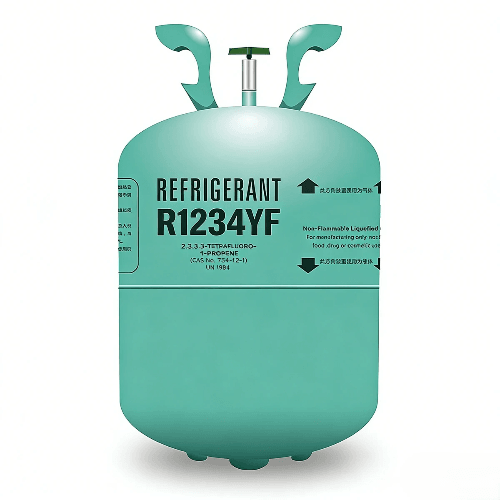
R1234yf
R1234yf is a fourth-generation fluorinated refrigerant developed as an environmentally friendly alternative to R134a. With a global warming potential of less than 1, it has a significantly lower climate impact than previous refrigerants.
The chemical with CAS registry number 754-12-1 is classified as an A2L refrigerant (lower flammability) and is approved for use in mobile air conditioning systems under EU Mobile Air Conditioning Directive and US EPA SNAP regulations.
This HFO refrigerant offers similar thermodynamic properties to R134a, making it suitable for direct replacement in many systems with minimal modifications.
Applications
Mobile Air Conditioning
Primary refrigerant for new automotive AC systems, mandated in the EU and widely adopted globally as replacement for R134a.
Residential Refrigeration
Used in domestic refrigerators, freezers, and chillers where low GWP and energy efficiency are required.
Commercial Refrigeration
Applied in supermarket display cases, cold storage rooms, and commercial chillers.
Industrial Cooling
Used in industrial process cooling, heat pumps, and specialized cooling applications.
Transport Refrigeration
Refrigerant for truck and trailer refrigeration units, replacing higher GWP alternatives.
Stationary AC Systems
Growing application in small to medium stationary air conditioning systems.
Physical & Chemical Properties
Basic & Physical Properties
Molecular Weight: 114.04 g/mol
Normal Boiling Point: -29.45 °C to -29.5 °C
Critical Temperature: 94.7 °C
Critical Pressure: 33.82 bar (3.38 MPa)
Liquid Density: 1,091.91 kg/m³ (0°C) / 1,160.40 kg/m³ (5°C)
Latent Heat (Vaporization): 160.02 kJ/kg (at 5°C)
Liquid Viscosity: 197.10 μPa·s (at 5°C)
Thermal Conductivity: 69.95 mW/m·K (at 5°C)
Temperature Glide: < 1.74 °C (0.1–2 MPa)
Chemical & Safety Properties
Flammability Limits:
Lower (LFL): 6.5% by volume (72 g/m³) .
Upper (UFL): 12.3% by volume (135 g/m³) .
Note: Compared to R290 (propane, A3), R1234yf has a much narrower flammable range and is harder to ignite .
Auto-ignition Temperature: 405 °C
Reactivity: Stable under normal conditions, but can react violently with strong oxidizing agents. Decomposes in fire, potentially releasing hydrogen fluoride (HF) .
Handling & Operational Notes
Solubility: R1234yf is water-soluble . (Note: In refrigeration systems, water is generally a contaminant; proper dehydration during service is critical).
Charge Limits: Due to A2L flammability, international standards (IEC 60335-2-89) limit charges. Recent updates allow up to 1,200g for A2L refrigerants in self-contained commercial appliances (up from 150g), provided specific safety measures are met .
Toxicity & Exposure: Generally low toxicity, but direct contact can cause irritation to eyes, skin, and respiratory tract. Inhalation of high concentrations may cause dizziness or asphyxiation .
Compatibility: R1234yf is not a direct "drop-in" for R134a or R404A systems. It requires specific PAG oils and component re-engineering (compressors, expansion devices) due to different pressures and material compatibility
Packaging, Storage & Transportation
Packaging Options
Available in disposable cylinders (10kg, 25kg), returnable cylinders (450kg, 1000kg), and ISO containers for bulk transport. All containers are color-coded (red with light blue shoulder) and labeled according to UN and regional regulations.
Storage Guidelines
Store in a cool, dry, well-ventilated area away from direct sunlight and ignition sources. Storage temperature should not exceed 50°C (122°F). Cylinders should be stored upright and secured to prevent tipping.
Transportation
Classified as UN 3163, liquefied gas, flammable, n.o.s. (2,3,3,3-tetrafluoropropene). Transport under Class 2.2 with flammable subsidiary risk. Requires proper documentation, labeling, and compliance with transport regulations (DOT, ADR, IMDG, IATA).
Handling
Use appropriate personal protective equipment (PPE). Ensure adequate ventilation. Use leak detection equipment as R1234yf has a faint ether-like odor at high concentrations. Follow ASHRAE Standard 15 and local regulations for refrigerant handling.
FAQ
What is R1234yf?
What is the CAS number for R1234yf?
What is the GWP (Global Warming Potential) of R1234yf?
What is the ODP (Ozone Depletion Potential) of R1234yf?
Can R1234yf be used as a direct replacement for R134a?
What are the main applications of R1234yf?
What is the boiling point of R1234yf?
What safety precautions are needed when handling R1234yf?
What is the molecular weight of R1234yf?
Is R1234yf compatible with mineral oil?
What is the critical temperature of R1234yf?
How does R1234yf compare to R134a in terms of performance?
What are the environmental regulations affecting R1234yf?
Can R1234yf be mixed with other refrigerants?
What is the atmospheric lifetime of R1234yf?
How is R1234yf transported and stored?
What leak detection methods are recommended for R1234yf systems?
What are the disposal and recycling requirements for R1234yf?
Refrigerants
Second Refrigerant
R22
Third Generation
R32
R23
HFC-143A
R134A
HFC-125
R152A
Blended Refrigerant
R404A
R407C
R410A
R507A
Fourth Generation
R1234YF
UV Series
UV absorber
UV-1164
BP-2
UV-1
UV-123
UV-327
UV-P
UV-329
UV-1130
Light satabilizers
UV-292
UV-770
Melanin
2-Anilino-6-(dibutylamino)-3-me
Other chemicals
2-Hydroxy-2methylpropiophenone
1,3-benzothiazol-2-ylsulfanylme
4-Chloro-3,5-dimethylphenol (CA
About
Home
News
Contact
© 2025 Shandong Do Sender Chemicals Co.,Ltd. All rights reserved.
Sales Office Address:No. 66, Zhongrun Avenue, Zhangdian District, Zibo City, Shandong Province,China.
Manufacture Facility: Fine Chemical Industry Park, Zhangdian District, Zibo City, Shandong Province,China.
Refrigerants +86 15315229135 +8616678643891 Email:wings.fu@dosenderchem.com.cn quinn.gong@dosenderchem.com.cn